Standard dimethicone gives slip, but it is optically bland and thermally ordinary. Phenyl silicones add three properties that matter in color cosmetics and sun care: a high refractive index that makes skin and pigments look luminous, a phenyl ring that raises heat stability, and a hydrophobic backbone that helps films resist sweat and water. In hot, humid Southeast Asia and in the strong sun of the Middle East, those three properties translate directly into longer wear, better gloss and fewer midday touch-ups. This article explains how Damongwz W555 (Trimethyl Pentaphenyl Trisiloxane) and W556 (Phenyl Trimethicone) fit into foundations, lipsticks and sunscreen formulations.
What phenyl silicones do that dimethicone cannot
Phenyl silicones are dimethyl polysiloxanes in which some methyl groups have been replaced by phenyl groups. That small structural change produces a big performance shift:
- Higher refractive index. Dimethicone sits around 1.40. Phenyl trimethicone reaches roughly 1.46, and trimethyl pentaphenyl trisiloxane can exceed 1.50. On skin, that means more light reflection, a dewier finish and better compatibility with high-gloss pigments.
- Better thermal stability. The phenyl group raises the oxidative and thermal ceiling. For lipsticks, cream shadows and sunscreens that sit in a hot bag or car, this reduces separation, odor development and color drift.
- Stronger film formation. Phenyl silicones spread into continuous, flexible films that anchor pigments and UV filters without the tackiness of some hydrocarbon film formers.
- Water and sebum resistance. The hydrophobic film repels both sweat and sebum, which is why phenyl silicones appear in long-wear foundation and water-resistant sunscreen.
These properties explain why a foundation built on phenyl silicone looks more "luminous-skin" than "makeup sitting on skin," and why a sunscreen stays intact through a humid afternoon.
W555 vs W556: two phenyl grades, two jobs
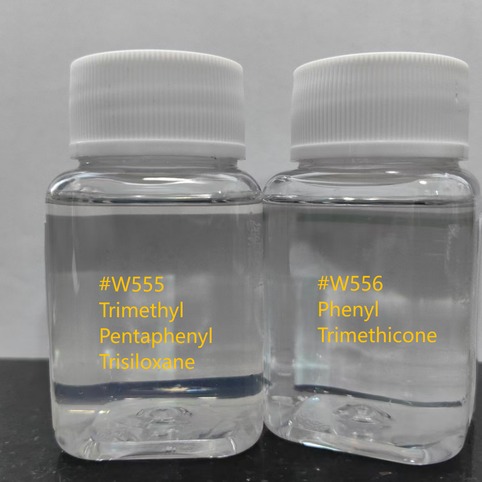
Both grades are clear, low-viscosity liquids with a phenyl-modified silicone backbone, but the number of phenyl groups and the chain length change the feel and the function.
| Grade | INCI name | Refractive index | Key feel | Best for |
|---|---|---|---|---|
| W555 | Trimethyl Pentaphenyl Trisiloxane | ~1.50+ | Very light, ultra-glossy, fast-spreading | High-gloss lipstick, lip gloss, eye shadow, pressed pigments, luminous foundation |
| W556 | Phenyl Trimethicone | ~1.46 | Silky, smooth, slightly more substantive | Long-wear foundation, sunscreen, primer, hair serum, heat-protectant styling products |
W555 is the more optical grade. Its five phenyl groups push the refractive index high enough to make pigments look wet and dimensional, which is why it is common in lip gloss and eye shadow formulations. W556 is the more balanced grade: it still adds gloss and improves film integrity, but it spreads more slowly and leaves a slightly more cushiony film, which is preferable when the product has to last for hours.
See the full phenyl-silicone-fluid range and COA notes.
Where phenyl silicones show up in real SKUs
The choice between W555 and W556 usually comes down to whether the brief is about looks or about longevity.
| Product type | Lead grade | Why this one |
|---|---|---|
| High-gloss lipstick / lip gloss | W555 | Highest refractive index gives a glassy, dimensional finish without stickiness. |
| Long-wear foundation / cushion BB | W556 | Builds a flexible, water-resistant film that holds pigment through heat and humidity. |
| Sunscreen (chemical, mineral or hybrid) | W556 | Improves spread, reduces white cast and helps the film resist wash-off. |
| Eye shadow / pressed pigment | W555 | Binds pigment, intensifies shimmer and gives a wet-looking payoff. |
| Hair serum / heat protectant | W556 | Spreads through hair, reduces friction and raises thermal stability under blow-dry or flat-iron heat. |
Formulation notes for hot and humid climates
Phenyl silicones are easy to work with, but a few details determine whether they perform in a tropical market.
- Use level. Most color-cosmetic formulas use 1–5% phenyl silicone. Above 5% the film can become too glossy or migrate; below 1% the optical and film-forming benefits are hard to see.
- Pair with the right volatile carrier. W556 combines well with low-viscosity dimethicone (W201) or methyl trimethicone (W202) to keep the initial spread light. W555 is often used neat or with a small amount of volatile silicone because its role is optical.
- Pigment wetting. Phenyl silicones wet most organic and inorganic pigments better than standard dimethicone. Pre-disperse pigments in W555 or W556 before adding them to the bulk to reduce streaking and improve payoff.
- Stability testing. Because phenyl silicones raise thermal stability, test at 45°C for at least four weeks and include a freeze-thaw cycle. Watch for separation at the interface with highly polar oils or glycols.
For brands also reformulating around D4/D5 restrictions, our D5 switchover playbook covers compliant volatile alternatives that pair with phenyl silicones.
Why the Middle East and Southeast Asia matter for this grade
Two regional dynamics make phenyl silicones a priority SKU for Damongwz.
Middle East color cosmetics. High ambient temperatures, strong UV and a preference for full-coverage, long-wear makeup create demand for heat-stable, water-resistant film formers. W556 in particular fits foundation, primer and sunscreen lines aimed at Dubai, Riyadh, Amman and Cairo.
Southeast Asian sun care. Consumers in Vietnam, Thailand, Indonesia and the Philippines expect sunscreen to survive sweat, humidity and re-application under a mask. A silicone film based on W556 helps a formula stay colour-true and avoid the white-cast migration common in O/W systems.
In both regions, the value proposition is the same: less touch-up, more confidence in the wear claim.
Three mistakes that waste phenyl silicones
- Using W555 where W556 is needed. A glossy lip formula needs W555; a foundation that must last eight hours needs W556. Swapping them produces either poor wear or poor shine.
- Overloading for gloss. More W555 does not always mean more shine. Past 5% the film can migrate into fine lines or feel greasy, especially on oily skin.
- Ignoring polarity. Phenyl silicones are compatible with many oils, but highly polar solvents or high glycerin levels can cause clouding or separation. Compatibility tests should be part of the first bench trial.
For a broader look at silicone selection by viscosity, see our cosmetic dimethicone viscosity guide. For matching an existing trademarked grade by spec, the spec-matching guide covers the five data points that matter.
FAQ
What is the difference between W555 and W556?
W555 is trimethyl pentaphenyl trisiloxane, a highly phenylated grade with a refractive index above 1.50, used when the goal is maximum gloss and optical clarity in lip, eye and pigment products. W556 is phenyl trimethicone, with a refractive index around 1.46 and a more balanced, substantive feel, used when the goal is long-wear film formation, water resistance and heat stability in foundation, sunscreen and hair care.
Can phenyl silicones replace dimethicone in a foundation?
They can replace part of it, but not all of it. Dimethicone still provides the base slip and spread. Phenyl silicone is added at 1–5% to improve gloss, film integrity and water resistance. The best formulas use both: dimethicone for spread, phenyl silicone for the luminous, long-wear finish.
Are phenyl silicones safe for leave-on cosmetics?
Yes. Phenyl trimethicone and trimethyl pentaphenyl trisiloxane are well-established cosmetic ingredients with published safety profiles and broad global acceptance. As with any raw material, use the cosmetic grade, request a COA and keep documentation aligned with your local cosmetic notification requirements.
Which grade is better for water-resistant sunscreen?
W556 is usually the better starting point for sunscreen. It forms a more flexible, water-resistant film than W555 and helps mineral and chemical UV filters spread evenly, reducing white cast and improving wash-off resistance. W555 can be added at a lower level if a glossy skin finish is also desired.