Ask two suppliers for “dimethicone” and you will get two very different liquids. One is water-thin and disappears on the skin; the other pours slowly and leaves a cushion. Both are dimethicone. The difference is viscosity, measured in centistokes (cSt) — and it is the single number that decides whether your cream feels expensive or feels greasy. This guide covers the range we actually sell, 5 to 1000 cSt, and starts with the question that matters more than viscosity: is the material you are buying really cosmetic grade?
First: cosmetic grade is not industrial grade
Industrial dimethicone and cosmetic dimethicone share the same CAS number (9006-65-9) and the same INCI name. On a spreadsheet they look identical. In a formulation they are not the same material.
Industrial grades are made to lubricate moulds, kill foam in a fermentation tank, or soften textile fibres. Nobody smells the mould release agent, so nobody controls odour, colour or trace metals to cosmetic tolerances. A batch can carry residual catalyst, ionic salts, a yellow tint and a faint amine smell, and still be a perfectly good industrial product.
Cosmetic grade is made differently, starting with the feedstock. Our W201 is produced from non-cracked virgin silicone feedstock and high-purity water, not from reclaimed or cracked siloxane, and every lot is released against the limits declared in our cosmetic raw-material safety filing:
| Item | W201 cosmetic-grade specification |
|---|---|
| INCI / CAS | Dimethicone (polydimethylsiloxane) · CAS 9006-65-9 |
| Purity | ~100% active silicone |
| Appearance | Colourless, transparent, no visible haze |
| Viscosity range | 5 – 1000 cSt (nine standard grades) |
| Volatile matter | Controlled by grade, within 0–40% |
| Heavy metals | Pb, As, Hg, Cd each ≤ 0.2 mg/kg |
| Residual cyclics | D4 typically below 100 ppm — well under the 0.1% EU limit |
| Declared use level | Leave-on 2–30% · Rinse-off 2–10% |
Values above are taken from our cosmetic raw-material safety filing for the W201 series; per-batch COA is issued with every shipment.
What cSt actually means when you touch it
cSt (centistokes) is a measure of how slowly a liquid flows. The higher the number, the thicker the liquid and the heavier it feels on skin. You do not need a rheometer to understand it — you need the kitchen:
| Viscosity | Flows like | What you feel on skin |
|---|---|---|
| 5–10 cSt | Water | Spreads instantly, almost disappears, no cushion |
| 20–50 cSt | Light vegetable oil | Light slip, quick absorption, clean finish |
| 100 cSt | Liquid soap | Noticeable slip, light protective film |
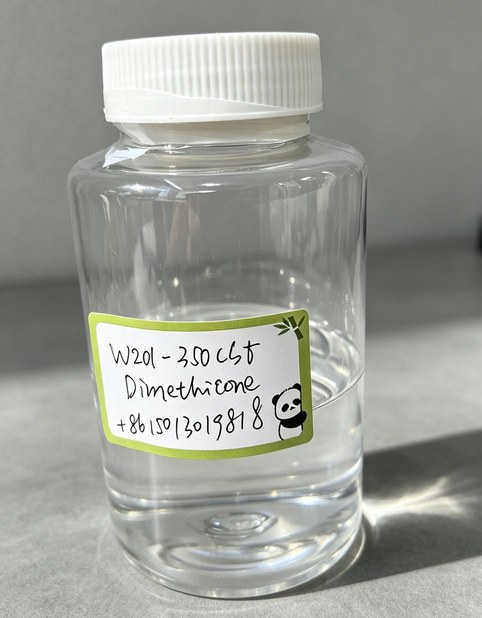
| 350 cSt | Light honey | The classic “silicone” feel: cushion, glide, soft afterfeel |
| 500–1000 cSt | Thick syrup | Heavy film, strong barrier, can read as greasy if overdosed |
Viscosity does not change what the molecule is. It only changes how long the polymer chain is, and therefore how it moves. That is why the same INCI name can feel like a mist or like an ointment.
Pick by viscosity: the 5–1000 cSt map
This is the table we send most often to formulators and procurement teams. Start from the feel you want in the finished product, then read back to the viscosity.
| Viscosity | Best in | Typical use level | Why this one |
|---|---|---|---|
| 5–10 cSt | Hair mist, sprayable serum, refreshing body lotion, makeup remover | 1–10% | Lightest feel available. Gives slip and spreadability without any heavy afterfeel — the closest thing to a cyclomethicone-like dry touch without the cyclics. |
| 20–50 cSt | Daily body lotion, facial essence, cleansing oil, shampoo conditioning | 1–5% | The everyday workhorse range. Adds smoothness to an emulsion at a level nobody notices as “silicone”. |
| 100 cSt | Face cream, hand cream, light sunscreen | 1–5% | A safe first choice when a formula needs a light protective film and better spread. |
| 350 cSt | Rich cream, sunscreen, hair conditioner, primer | 1–5% | The benchmark grade. If you are unsure, start here — it is the viscosity most published formulations are written around. |
| 500 cSt | Night cream, barrier cream, hair mask | 1–5% | More cushion and longer-lasting softness; good where the brief says “nourishing”. |
| 1000 cSt | Protective ointment, hair serum, occlusive treatment | 0.5–3% | Heaviest film and strongest water-barrier effect. Use sparingly — a little goes a long way. |
A simple rule of thumb: the lighter the product concept, the lower the viscosity. A refreshing body mist at 350 cSt will feel wrong; a barrier cream at 10 cSt will feel like it does nothing.
Inside our W201 series
W201 is our cosmetic-grade dimethicone line, covering nine standard viscosities between 5 and 1000 cSt. Every grade is produced from non-cracked virgin feedstock and high-purity water, with heavy metals held at or below 0.2 mg/kg and residual cyclics kept far under the EU 0.1% threshold.
Practical notes for anyone ordering for the first time:
- Ask for a sample set of three. Most customers test 10, 100 and 350 cSt side by side, then narrow to one.
- Request the COA with the sample. Viscosity, appearance, heavy metals and cyclics should all appear on it — if a supplier cannot send that before you buy, that is the answer.
See the full range and grade list under Basic Silicone Fluids, or browse all categories. If cyclics compliance is part of your brief, our D4 / D5 ASEAN regulation guide explains the limits that apply in Southeast Asia and the EU.
FAQ
Are silicone oil and dimethicone the same thing?
Yes in most commercial usage. Dimethicone (polydimethylsiloxane, CAS 9006-65-9) is the INCI name; silicone oil and silicone fluid are the trade shorthand for the same family of linear silicone polymers. The important detail is not the name but the viscosity and the grade: cosmetic-grade dimethicone and industrial-grade dimethicone carry the same CAS number while being made to very different purity and documentation standards.
Can I use industrial-grade dimethicone in a cosmetic product?
It is not recommended. Industrial grades are not released against cosmetic limits for heavy metals, odour, colour and residual catalyst, and they usually carry no cosmetic raw-material safety documentation. Using one in a leave-on product risks failing incoming inspection, finished-product heavy-metals testing and brand-owner audits, which costs far more than the price difference per kilo.
Which viscosity should I start with if I am not sure?
Start with 350 cSt. It is the most widely published and most commonly formulated viscosity, and it gives the slip and cushion most people mean when they say silicone feel. From there, move down to 100 cSt if the product needs to feel lighter, or up to 500 to 1000 cSt if the brief calls for a richer, more protective film.
Does a higher viscosity mean better performance?
No. Higher viscosity means a thicker liquid and a heavier film on skin, not a stronger or safer material. A 1000 cSt dimethicone used at 3% in a light day cream will feel greasy and may pill, while the same formula at 100 cSt or 350 cSt will feel clean. Choose viscosity to match the feel you want, and adjust the use level separately.