When a formulator says “I want to replace DOWSIL 9041,” what they usually mean is “I want the same skin feel.” The mistake is looking for an identical twin. No two silicone grades are identical — and you do not need them to be. You need the spec points that drive the feel to line up, and then you validate the result on skin or hair. This is the method our sourcing desk uses when a buyer hands us a competitor INCI name instead of a brief.
Why “find me the same one” fails
Trademarks are the first trap. Brand names like DOWSIL, BELSIL or KF-series belong to their owners; a supplier who claims “XXX is exactly 9041” is either guessing or overstepping a trademark. The useful question is functional: what does the grade do in the formula, and which numbers prove it?
The second trap is the INCI name alone. Two elastomer gels can share the identical INCI line — Cyclopentasiloxane (and) Dimethicone Crosspolymer — and still feel completely different because the carrier ratio, active content and cross-link density are not written on the label. The INCI name tells you the family. The spec sheet tells you the grade.
The five spec points that actually matter
When we receive a “replace this grade” request, we pull these five points from the current COA and the target spec sheet. If four of five match, a bench trial usually closes the gap.
| # | Spec point | Why it drives feel | Where to read it |
|---|---|---|---|
| 1 | INCI name | Confirms the polymer family (linear fluid vs. cross-linked gel, volatile vs. substantive) | COA / TDS header |
| 2 | Viscosity | Decides spread, cushion and film thickness on skin | TDS “Viscosity” row |
| 3 | Volatility / evaporation profile | Governs dry-down time and after-feel (oily vs. dry-touch) | Carrier type + volatile content |
| 4 | Refractive index | Controls shine vs. matte and white-cast in transparent formulas | TDS “RI (25°C)” row |
| 5 | Cyclics residue (D4 / D5 / D6) | Determines ASEAN / EU compliance headroom | Per-batch GC-MS on COA |
Worked example 1: W901 vs DOWSIL 9041 / 9241
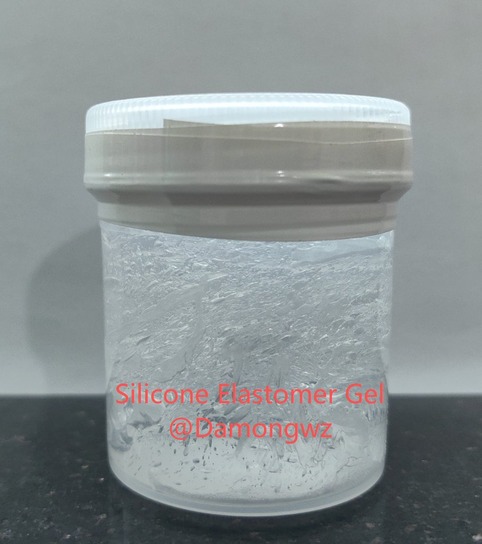
A buyer in the Philippines asked us to match a silicone elastomer gel used at 8% in a matte primer. Their current material is listed as DOWSIL 9041 (and in some formulas DOWSIL 9241). Both are cyclopentasiloxane-based dimethicone crosspolymer gels.
| Spec point | DOWSIL 9041 / 9241 (typical) | Damongwz W901 | Match? |
|---|---|---|---|
| INCI name | Cyclopentasiloxane (and) Dimethicone Crosspolymer | Cyclopentasiloxane (and) Dimethicone Crosspolymer | Yes — same family |
| Active content | ~13–15% | ~13.5% | Yes |
| Viscosity (25°C) | ~300,000 cSt | 300,000–400,000 cSt | Yes — overlapping range |
| Carrier | Cyclopentasiloxane | Cyclopentasiloxane | Yes |
| Feel signature | Light velvet, strong oil control | Light velvet, strong oil control | Yes — benchmark reference grade |
| Cyclics (D4 / D5 / D6) | Per supplier COA | Each < 0.1% | Verify per lot |
On the spec sheet, W901 lines up on four of the five points with a typical 9041 / 9241. The remaining work is a small bench trial — confirm dry-down time and oil-control over an 8-hour wear panel, then lock the use level. See the full elastomer-gel range.
Note: we do not claim W901 is identical to any trademarked product. The comparison is against the published typical specification of the named grades; actual lots vary by supplier and batch.
Worked example 2: W909 vs Wacker EG 2
A Vietnam formulator needed a substitute for Wacker BELSIL EG 2, a cyclopentasiloxane-based gel built on a dimethicone / vinyl dimethicone crosspolymer network. The vinyl-modified cross-link gives a softer, more powdery film than a standard crosspolymer — a detail the plain INCI name hides.
| Spec point | Wacker BELSIL EG 2 (typical) | Damongwz W909 | Match? |
|---|---|---|---|
| INCI name | Cyclopentasiloxane (and) Dimethicone/Vinyl Dimethicone Crosspolymer | Cyclopentasiloxane (and) Dimethicone/Vinyl Dimethicone Crosspolymer | Yes — same family |
| Active content | ~13–15% | ~13.5% | Yes |
| Viscosity (25°C) | ~300,000 cSt | 300,000–400,000 cSt | Yes — overlapping range |
| Feel signature | Soft, powdery, film-forming | Soft, powdery, film-forming | Yes — vinyl-modified network |
| Cyclics (D4 / D5 / D6) | Per supplier COA | Each < 0.1% | Verify per lot |
W909 matches EG 2 on the cross-link chemistry (the vinyl modification that gives the powdery finish) and on the four measurable spec points. The validation step here is subtler than for W901: because the vinyl network changes film-forming behaviour, run a spread test on the actual substrate (skin patch or hair swatch) before scaling. Compare all W901–W910 elastomer gels.
Three mistakes that blow up a switchover
Across the replacements we have supported, the same three errors cause most failures:
- Matching the name, not the number. Two grades with the same INCI can differ 5× in viscosity. Always start from the TDS row, not the brand name.
- Skipping the cyclics check. A perfect-feel gel that arrives at 0.3% D5 is a compliance problem in Vietnam and the EU. Verify D4 / D5 / D6 on the incoming COA before the trial, not after the batch is made.
- Assuming 1:1 use level. Even a close match usually needs a small use-level nudge (±1–2%) to reproduce dry-down and after-feel. Budget two bench iterations, not one.
For the broader replacement question on volatile carriers, our D5 switchover playbook covers W201 / W202 / W203 against cyclopentasiloxane. For choosing the right base fluid by viscosity, see the 5–1000 cSt dimethicone guide.
FAQ
Can you tell me W901 is identical to DOWSIL 9041?
No, and we would not claim it. Trademarked grades belong to their owners. What we can show is that W901 shares the same INCI family, similar active content and an overlapping viscosity range with a typical 9041 / 9241 specification, which makes it a strong candidate for a bench trial. The final confirmation is always a feel test on your formula and substrate.
What documents should I request before switching a grade?
At minimum: the current material's COA (with D4 / D5 / D6 per batch), the target grade's TDS, and an MSDS for both. The COA tells you the cyclics residue and viscosity; the TDS tells you the carrier, active content and refractive index. If a supplier cannot send a per-batch COA with cyclics data before you buy, that is the answer.
How long does a grade switch usually take?
For a close spec match, the calendar is short: sample request (3–7 days), bench trial with a small use-level adjustment (1–2 weeks), and a feel / wear panel (1–2 weeks). The work expands only if the volatility or cross-link chemistry differs, which can add a stability check. Most straightforward elastomer-gel swaps close inside a month.
If the INCI name matches, do I still need to reformulate?
Usually yes, at least slightly. The INCI name omits carrier ratio, active content, viscosity and cross-link type — all of which change skin feel. Plan for a small use-level adjustment and a short validation panel rather than a direct 1:1 drop-in, even when the INCI line is identical.