Walk into any hair-care factory in Vietnam, Indonesia or the Philippines and the formulator will have at least one amino silicone on the bench. Amino silicones are the workhorse conditioning agents in shampoos, conditioners, hair masks and leave-on treatments because they do something no ordinary oil can do: they stick to damaged hair, smooth the cuticle and cut combing friction without weighing healthy hair down. We make them in two forms — neat amino silicone oil that you disperse yourself, and ready-to-use amino silicone oil emulsion that drops straight into the kettle. This article explains what is actually happening on the hair, how to tell the two forms apart, and how to choose between W601, W602, W603, W621, W622 and W623 by amine value, viscosity and rinse-off vs leave-on formula.
Why hair needs silicone in the first place
Healthy hair is covered by a flat layer of cuticle scales that reflect light and let strands slide past each other. Bleaching, heat styling, sun and alkaline relaxers lift those scales. Once lifted, the surface becomes rough, hair tangles, light scatters instead of reflecting, and the fibre feels dry.
Amino silicone solves this through two mechanisms:
- Cationic adsorption. Amino groups on the silicone backbone carry a positive charge. Damaged hair is negatively charged. The two attract, so the silicone deposits exactly where the cuticle is most damaged rather than rinsing straight down the drain.
- Film-forming. Once deposited, the silicone spreads into a thin, flexible film that lays the cuticle flat again. This restores slip, reduces friction and gives the characteristic smooth, conditioned feel.
The result is easier wet combing, easier dry combing, less static, less breakage and a visible gloss. The trade-off is that the wrong grade — or the right grade at the wrong level — can feel greasy, build up or turn a transparent formula cloudy.
Two forms: neat amino silicone oil vs ready-to-use emulsion
Before comparing grades, it helps to know the two physical forms our range comes in — because the form decides how much work you do in the lab.
| Form | What it is | You do the work? | Best when |
|---|---|---|---|
| Amino silicone oil | The neat, 100% active fluid (W601, W602, W603) | Yes — you pre-emulsify or disperse it before adding | You want maximum flexibility, lowest cost per kilo, and control over particle size |
| Amino silicone oil emulsion | The silicone already dispersed in water with a non-ionic emulsifier (W621, W622, W623) | No — it is pump-and-go, water-dispersible | You need a clear or translucent base, fast batching, or a stable microemulsion without your own homogeniser |
The emulsions are the pragmatic choice for transparent shampoos and for factories without a high-shear mixer: the silicone is already at ultra-small particle size, so it stays clear and does not haze. The neat oils give you the raw material to build your own emulsion if you want a specific particle size or a blended feel.
Amodimethicone vs Bis-Aminopropyl Dimethicone
Both are amino-functional silicones, but the shape of the amino group changes how the material behaves on hair.
| Type | INCI name | What the amino group does | Typical feel |
|---|---|---|---|
| Amodimethicone | Amodimethicone | Smaller amino groups, higher cationic charge density; adsorbs strongly to damaged areas | Soft, smooth, thermal protection, good for everyday shampoo/conditioner |
| Bis-aminopropyl dimethicone | Bis-Aminopropyl Dimethicone | Two amino groups per site, larger molecule; stronger film and higher gloss | Sleek, high shine, excellent on bleached or chemically treated hair |
The amino value on the COA tells you how “charged” the silicone is. A higher amine value means stronger adsorption and more conditioning, but also more care in transparent formulas because high-charge grades can haze or yellow over time.
The grades: W601–W603 neat oils and W621–W623 emulsions
Both forms share the same job — deposit a conditioning film on hair — but the grades split by chemistry and by how they are supplied. Here is the full working set.
Neat amino silicone oils (you disperse)
| Grade | INCI / type | Viscosity | Amine value | Best for |
|---|---|---|---|---|
| W601 | Amodimethicone | 1,000–3,000 cSt | 0.60 | The versatile all-rounder: thermal protection, soft feel, strong adsorption in standard shampoo/conditioner |
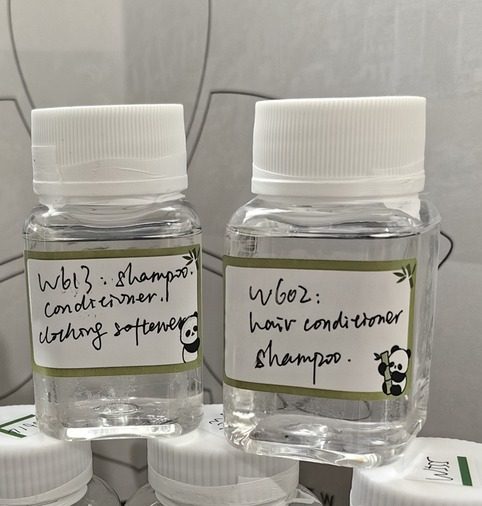
| W602 | Amodimethicone | 1,000–1,400 cSt | 0.26 | Low-yellowing, high-smoothness grade that emulsifies easily into a transparent microemulsion — good for white/pastel or clear bases |
| W603 | Bis-Aminopropyl Dimethicone | 4,000–18,000 cSt | 0.08 | The repair/gloss specialist: heavier film, high shine, for bleached or chemically treated hair |
Ready-to-use amino silicone emulsions (water-dispersible)
| Grade | INCI / type | pH | Emulsifier | Best for |
|---|---|---|---|---|
| W621 | Amodimethicone (and) Trideceth-12 | 4.0–6.0 | Non-ionic | Blue-phase transparent microemulsion; soft, fluffy feel in clear products and wig processing |
| W622 | Bis-Aminopropyl Dimethicone (and) Trideceth-12 | 4.0–6.0 | Non-ionic | Emulsion of the bis-aminopropyl grade — repair/gloss in a ready-to-use form |
| W623 | Amodimethicone (and) Trideceth-12 | 4.0–6.0 | Non-ionic | Translucent to emulsion liquid; easy pump-and-go conditioning for everyday batches |
Read the amine value on the COA as the material’s “charge”: W601 (0.60) adsorbs hard and conditions strongly, while W602 (0.26) and W603 (0.08) are gentler on colour and clarity. Full specifications and COA notes are on the Amino Silicone Oils and Emulsions page.
How to choose by amine value, viscosity and formula type
This is the part formulators actually ask for. Start from three numbers, then match the form to your base.
1. Amine value — how much conditioning, how much risk
The amine value (mmol/g on the COA) sets how strongly the silicone grabs negatively charged, damaged hair. Higher means stronger conditioning and better wet/dry slip — but also more yellowing and haze risk in clear or low-pH formulas.
- W601 (0.60) — strong, general-purpose. Best for opaque rinse-off where you want maximum softness per gram.
- W602 (0.26) — the low-yellowing option. Choose it for white, pastel or transparent bases where a high-charge grade would haze or tint.
- W603 (0.08) — gentlest charge, heaviest film. The repair/gloss grade for treated hair, not for clear bases.
2. Viscosity — light slip vs heavy luxury
Within the neat oils, viscosity sets the film weight. W601/W602 at 1,000–3,000 cSt (W602 narrower at 1,000–1,400) feel light and non-dragging; W603 at 4,000–18,000 cSt builds a thicker, glossier, more luxurious film. If you want body without weight, stay in the W601/W602 band.
3. Rinse-off vs leave-on — and which form to use
Rinse-off products tolerate higher active levels (roughly 1–2%) because most washes down the drain; leave-on treatments need less (0.5–2%) to avoid build-up and limpness. For a clear or translucent base, skip the pre-dispersion step and use the emulsions (W621/W622/W623) — they are water-dispersible and stay clear. For an opaque, cost-driven batch, the neat oils (W601/W602/W603) give you the lowest cost per kilo of active.
Three mistakes that turn a good amino silicone bad
- Over-loading. More amino silicone does not mean more conditioning. Past the use-level sweet spot, hair goes from soft to limp and greasy, especially in tropical humidity.
- Wrong form for a clear formula. A neat amino silicone oil can haze a transparent base because it is not water-dispersible. For clarity, use the W621/W622/W623 emulsions or pre-emulsify the oil first.
- Ignoring yellowing. High-amine grades can yellow over time in formulations with oxidising ingredients or at very low pH. Test accelerated stability at 45°C for at least four weeks before locking the formula.
- Confusing oil with emulsion. Adding a neat oil like W601 straight into water will not disperse — it needs pre-emulsification or a high-shear mixer. If your line has neither, use the ready-to-use W621/W622/W623 emulsions instead.
For the broader question of when to use silicone and when to go silicone-free, our green-formulation guide covers practical “clean beauty” trade-offs. For choosing a dimethicone base fluid by viscosity, see the 5–1000 cSt dimethicone guide.
FAQ
What is the difference between W601 and W603?
Both are amino-functional silicones, but they have different chemistries and feels. W601 is amodimethicone with an amine value around 0.60 and a viscosity of 1,000–3,000 cSt; it gives a soft, smooth, thermal-protective film and is the best general-purpose grade. W603 is bis-aminopropyl dimethicone, with a higher viscosity of 4,000–18,000 cSt and a lower amine value of about 0.08; it builds a glossier, heavier repair film and is better for damaged or chemically treated hair.
Can I use amino silicone in a transparent shampoo?
Neat amino silicone fluids can haze a clear base because they are not water-dispersible. If transparency is important, use the W621/W622/W623 emulsions, which are supplied as water-dispersible microemulsions, or pre-emulsify the neat oil before adding it to the formulation.
Does amino silicone build up on hair?
Any conditioning agent can build up if used at too high a level or combined with other heavy film-formers. Amino silicones actually deposit preferentially on damaged areas and can be removed by normal shampooing. The key is to choose the right grade and use level for the hair type — lighter grades like W601 for normal hair, and reserve heavier grades like W603 for damaged hair.
What is the difference between amino silicone oil and amino silicone oil emulsion?
Amino silicone oil (W601, W602, W603) is the neat 100% active fluid — you pre-emulsify or disperse it yourself before adding to the formula. Amino silicone oil emulsion (W621, W622, W623) is the same active silicone already dispersed in water with a non-ionic emulsifier, so it is water-dispersible and pump-and-go. Use the emulsion when you need a clear or translucent base, fast batching, or do not have a high-shear mixer; use the neat oil when you want the lowest cost per kilo and full control over particle size.
How do I choose amino silicone oil by amine value?
The amine value on the COA (mmol/g) tells you how strongly the silicone deposits on damaged, negatively charged hair. A higher value means stronger conditioning and better wet/dry slip but more yellowing and haze risk in clear or low-pH formulas; a lower value is gentler on colour and clarity. In our range, W601 is 0.60 (strong, general-purpose), W602 is 0.26 (low-yellowing, good for white or transparent bases) and W603 is 0.08 (gentlest charge, heaviest repair film).