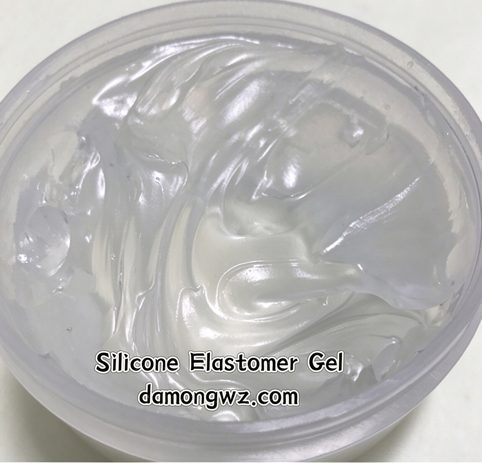
What a silicone elastomer gel is
A silicone elastomer gel is not a liquid oil and not a powder. It is a three-dimensional silicone network — typically a crosspolymer swollen inside a silicone or volatile carrier — that sits as a translucent or gel-like mass. Two facts matter for formulators:
- The performance (matte, velvety, oil-control, soft-focus) comes from the crosspolymer network.
- The feel and volatility come from the carrier it is dispersed in. Change the carrier, and you change the experience — that is the main lever when choosing a grade.
This is why the same family of ingredients answers so many different searches: it is a single technology that flexes from a cooling volatile skin feel to a long-wear film former, depending on what carries it.
The four jobs it does in personal care
In skin care and cosmetics, a well-chosen elastomer gel tends to do one or more of these:
- Oil control and a dry, matte finish. The network adsorbs sebum and leaves a powdery, non-greasy surface — the reason these gels show up in sebum-control primers.
- Sensory modifier: velvety slip. This is the most-searched benefit. A small addition turns a sticky formula into a silky, “cushion” feel on skin and hair.
- Soft-focus and wrinkle-blurring. The particles scatter light, visually softening fine lines — a staple in anti-ageing and make-up bases.
- Film and thickener in water-free systems. Several grades thicken W/O, O/W and anhydrous bases and add a breathable film, without needing water-phase thickeners.
Choose by carrier, not by category
The carrier decides the in-use feel. Here is the W901-W905 map by carrier type:
| Grade | Carrier | INCI (crosspolymer) | Best for |
|---|---|---|---|
| W901 | Cyclopentasiloxane (D5) | Cyclopentasiloxane (and) Dimethicone Crosspolymer | Oil-control, velvety touch; 13.5% content |
| W902 | Dimethicone | Dimethicone (and) Dimethicone/Vinyl Dimethicone Crosspolymer | Silky, moisturizing matte that does not dry out; 22.5% content; D4/D5/D6 < 0.1% |
| W9021 | Dimethicone (light, low-viscosity feel/very D5-like volatility) | Dimethicone (and) Dimethicone/Vinyl Dimethicone Crosspolymer | Velvety matt with a light, moist feel; 16.0% content; D4/D5/D6 < 0.1% |
| W903 | Dimethicone (high viscosity) | Dimethicone (and) Dimethicone Crosspolymer | Exceptional, long-lasting velvety matte; 16.0% content; D4/D5/D6 < 0.1% |
| W904 | Dimethicone (and) PEG-10 Dimethicone/Vinyl | Dimethicone (and) PEG-10 Dimethicone/Vinyl Dimethicone Crosspolymer | W/O co-emulsifier + colour-fixing; 27.0% content; D4/D5/D6 < 0.1% |
| W905 | Caprylyl Methicone | Caprylyl Methicone (and) Cetearyl Dimethicone/Vinyl Dimethicone Crosspolymer | High spreadability, powdery, light skin-fit; 26.0% content; D4/D5/D6 < 0.1% |
| W909 / W910 | Cyclopentasiloxane | Cyclopentasiloxane (and) Dimethicone/Vinyl Dimethicone Crosspolymer | Film-forming and multi-phase thickener; W910 also an oil-phase thickener |
Content and INCI are taken from the Damongwz W901-W905 specification. Grades marked D4/D5/D6 < 0.1% meet the EU REACH 2024/1328 and ASEAN ACD limits for residual cyclic siloxanes.
Pairing with soft silicone elastomer powders
For an even stronger matte and oil-absorbing effect, formulators often combine the gel with soft silicone elastomer powders — the W701-W704 microspheres. The powder adds sebum control and a powdery smoothness; the gel adds slip and cushion. Together they build the dry, blur-and-soft-focus finish now common in primers and cushions.
For the powder side of the same technology, see our guide to silicone elastomer powder for matte and blurring, and the full range on the silicone powders page.
Compliance: mind the residual cyclics
Note the two carrier types. In W902, W9021, W903, W904 and W905 the carrier is dimethicone or caprylyl methicone, and the grades are specified at D4/D5/D6 < 0.1%, inside the current EU REACH 2024/1328 and ASEAN ACD limits. In W901 the carrier is cyclopentasiloxane (D5) itself — that real D5 volatility is exactly the cooling, evaporating feel it delivers, but it also means the gel brings D5 into the formula, so for leave-on products under the 0.1% limit the low-cyclics grades above are the compliant choice. Always ask a supplier for the residual-cyclics number on the COA, not just the INCI name.
For the broader picture on linear vs cyclic silicone and the 0.1% limit, read our linear vs cyclic dimethicone guide.
Quick selection cheat-sheet
- Want a cooling, volatile, oil-controlling feel → W901 (cyclopentasiloxane carrier).
- Want silky matte that stays moist (no dry-out) → W902 or W9021.
- Want maximum, long-lasting matte → W903.
- Want a W/O co-emulsifier with colour-fixing → W904.
- Want high spreadability and a powdery light feel → W905.
- Want a thickener / film-former for anhydrous systems → W909 / W910.
The complete grade list, with full specifications, is on the silicone elastomer gels page.
FAQ
What is silicone elastomer gel used for in personal care?
It is used for oil control, a matte/soft-focus finish, velvety sensory slip and light-texture film forming in skin care, colour cosmetics and sun care. The crosspolymer network gives the matte and blurring effect; the carrier gives the in-use feel.
Are silicone elastomer gels the same as silicone powders?
No. Both are silicone crosspolymers, but gels are swollen in a silicone or volatile carrier (a paste/gel), while powders are free-flowing solids. They are often used together: powder for oil adsorption, gel for slip and cushion.
Which grade gives the strongest matte finish?
W903 (high-viscosity dimethicone carrier) gives the most exceptional, long-lasting velvety matte. For a softer, moist matte that does not dry the skin, choose W902 or W9021.
Are Damongwz elastomer gels cyclic-siloxane free?
The W902, W9021, W903, W904 and W905 grades are specified at D4/D5/D6 below 0.1%, inside the EU REACH 2024/1328 and ASEAN ACD limits. Ask for the residual-cyclics figure on the COA for any grade you buy.