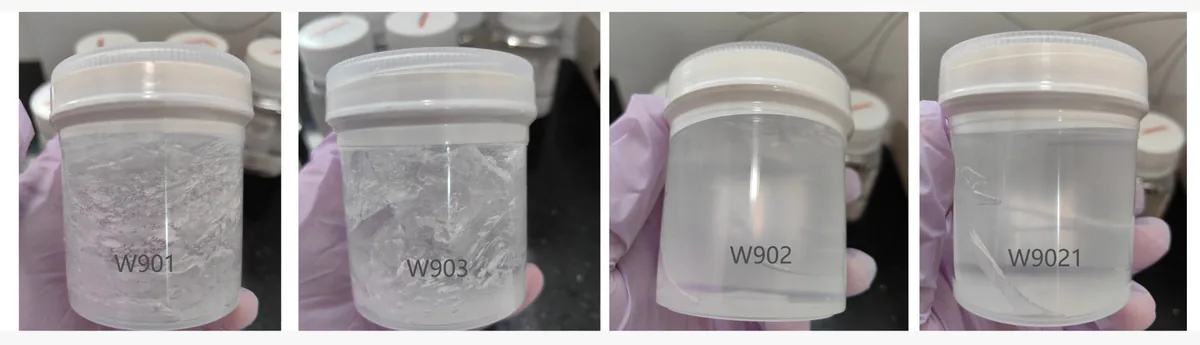
In the past three years, silicone elastomer gels have quietly become one of the most expensive — and most used — sensory ingredients in mainstream personal care. A premium sunscreen without an elastomer gel today feels out of place; a velvety primer without one is almost impossible. This guide is a working note for formulators, brand owners and procurement teams who keep hearing about W901 and W903 but are not sure which one to start with.
Why elastomer gels keep growing
Three things are happening at the same time, and they all push formulators toward elastomer gels and powders:
1. The "skinification" of color cosmetics. Foundation, primer, lip gloss and concealer are now formulated with the same expectations as a serum — long wear, comfort, no cakey finish, real skincare claims. Elastomer gels deliver the velvet, soft-focus blur and sebum control that consumers now associate with "premium" color cosmetics.
2. SPF texture has become a brand differentiator. Asian markets, especially China, Korea and Vietnam, treat sunscreen texture as the first purchase filter. The "second-skin" feel that elastomer gels give to a high-SPF formulation is now table stakes, not a luxury.
3. The silicone backbone is well understood. Twenty years of safety data and the move to low-cyclics carriers (see our D5 switchover guide) have made formulators comfortable working with silicone elastomers at 5–30% in a formula. The barrier to entry is now purely a sensory question, not a regulatory one.
What an elastomer gel actually does in a formula
At a typical use level of 5–20%, a silicone elastomer gel does three things at once, which is why it is so hard to substitute with a single other ingredient:
Thickening without weight. It builds viscosity on the silicone side of the formula, leaving the water phase light. The finished cream spreads thin and feels thin in the jar, but the film on the skin has body and bounce.
Matte and oil control. The cross-linked silicone network absorbs sebum throughout the day. A foundation that looks fresh at 9 a.m. still looks fresh at 5 p.m. because the elastomer gel is soaking up the shine, not a heavy powder that settles into lines.
Soft-focus blur. The light-scattering structure of the cross-polymer diffuses reflections on the skin surface, which is what consumers read as "wrinkle blurring" and "pore blurring." It is a physical, optical effect — no active claim required, no special test panel needed.
Where elastomer gels sit in real SKUs
If you open ten jars of finished product on a formulator’s bench, you will see elastomer gels doing very different jobs in each. The use level and the grade you pick depend entirely on the desired feel, not on the marketing claim.
| Product type | Typical use level | What the elastomer gel is doing |
|---|---|---|
| Premium day cream / night cream | 3–8% | Velvet after-feel, fast absorption, premium "bounce" without stickiness |
| High-SPF sunscreen (cream, lotion) | 5–12% | Reduces the "sunscreen drag," adds second-skin feel, helps disperse UV filters |
| Silicone-based primer / makeup base | 10–25% | Soft-focus blur, pore minimization, foundation grip |
| Lip gloss / lip oil | 5–15% | Body without tack, even pigment suspension, non-migrating film |
| Solid stick (deodorant, concealer, cleansing balm) | 3–10% | Smooth glide, stable structure, powder-binding capacity |
The same physical ingredient is doing five different jobs. The grade you choose and the percentage you use change which of those jobs you get.
Reading the W901–W905 family by feel
Damongwz offers five elastomer gel grades. They are all cyclics-free (D4 / D5 / D6 each below 0.1%) and built around low-volatility carriers, so they slot straight into formulations that already target the EU 2027 limit. The difference between grades is best described by feel:
| Grade | Carrier | Active content | Feel signature |
|---|---|---|---|
| W901 | Cyclopentasiloxane | ~13.5% | The classic. Light, fast-spreading velvet with strong oil control. The benchmark reference grade for color cosmetics. |
| W902 | Dimethicone | ~22.5% | Heavier, more cushion. Best in skincare creams and balms where a "moisturizing velvet" feel is the goal. |
| W9021 | Dimethicone | ~16% | Mid-weight, similar volatility profile to D5, very soft after-feel. A good bridge grade between W901 and W902. |
| W903 | Dimethicone | ~25% | Highest active content, strongest matte effect and longest wear. Workhorse for high-SPF and long-wear foundations. |
| W904 / W905 | Specialty carriers | Variant | Tailored carriers for specific compatibility challenges (anhydrous sticks, water-in-silicone systems, natural oil blends). |
Elastomer powders vs. elastomer gels: when to use which
Elastomer powders (our W701–W704 series) are the dry form of the same chemistry: cross-linked silicone particles, typically 1–15 µm, supplied as a free-flowing white powder. They deliver the same oil-control and soft-focus effect as a gel, but with a completely different formulation role:
Elastomer gel = builds the texture of the product itself. It is part of the formula’s structure, contributing slip, cushion and viscosity on the silicone side.
Elastomer powder = sits inside the formula as a soft, absorbent filler. It thickens powder compacts, mattifies pressed foundations, replaces some of the talk or mica in a loose powder, and improves the skin feel of an anhydrous balm.
You can use both in the same product. A typical combination is 8% W901 gel in the primer base plus 2% W703 powder in the finishing powder — the gel handles the in-jar feel and the blur on application, the powder handles the shine control through the day.
Three formulation tips from real batches
These are the three things our sourcing desk hears most often from brand formulators who are new to elastomer gels:
1. Add the gel to the oil phase, not the water phase. Even though elastomer gels feel "thick," they are silicone-based. They will not survive being poured into water at 70°C and homogenized. The grade should be added to the silicone or oil phase at cool-down, below 40°C, under slow sweep or low-shear mixing.
2. Total silicone load matters more than the elastomer percentage. A formula with 10% W901 plus 15% cyclomethicone substitute (W201 / W202) will feel very different from 10% W901 with 5% W201. The total silicone fraction, not the elastomer content alone, decides the velvet intensity. A good formulation brief specifies the target total silicone load upfront.
3. Match the carrier to your packaging. W901 (cyclopentasiloxane carrier) will lose weight faster in an open jar than W902 (dimethicone carrier). For a pump or tube, this does not matter. For an open jar or a stick, the low-volatility carrier grades keep the texture stable for longer.
FAQ
Is a silicone elastomer gel the same as a silicone oil?
No. Silicone oils (dimethicone, cyclomethicone, phenyl trimethicone) are linear polymers that flow and spread. Silicone elastomer gels are cross-linked polymer networks swollen in a silicone carrier — they hold shape, give cushion, and provide oil absorption that a fluid silicone cannot. They are usually used together, not as substitutes for each other.
What is the difference between an elastomer gel and an elastomer powder?
Same chemistry, different form. A gel is a swollen cross-polymer network in a silicone carrier (W901–W905). A powder is the dry cross-polymer supplied as 1–15 micron particles (W701–W704). Gels build the texture of a cream or primer; powders sit inside a pressed formula as an absorbent, soft-focus filler. Many finished products use both.
Can I use the same elastomer gel in skincare and color cosmetics?
Yes, with two caveats. First, a skincare formula usually needs a more cushioning, less matte grade (W902 over W901). Second, a color cosmetic usually needs higher loading and a lighter carrier (W901 or W903). The INCI name may match; the feel at use level will not. Always run a small panel test on the final formula before scaling up.
I am new to elastomer gels. Which Damongwz grade should I try first?
Start with W901 if your product is a primer, foundation, sunscreen or any color cosmetic. Start with W902 if your product is a day cream, night cream or cleansing balm. W9021 is a useful mid-point if you want one grade to cover both skincare and light color cosmetic lines. W903 is worth adding once you have a clear long-wear or high-SPF target. We can send reference samples on request.